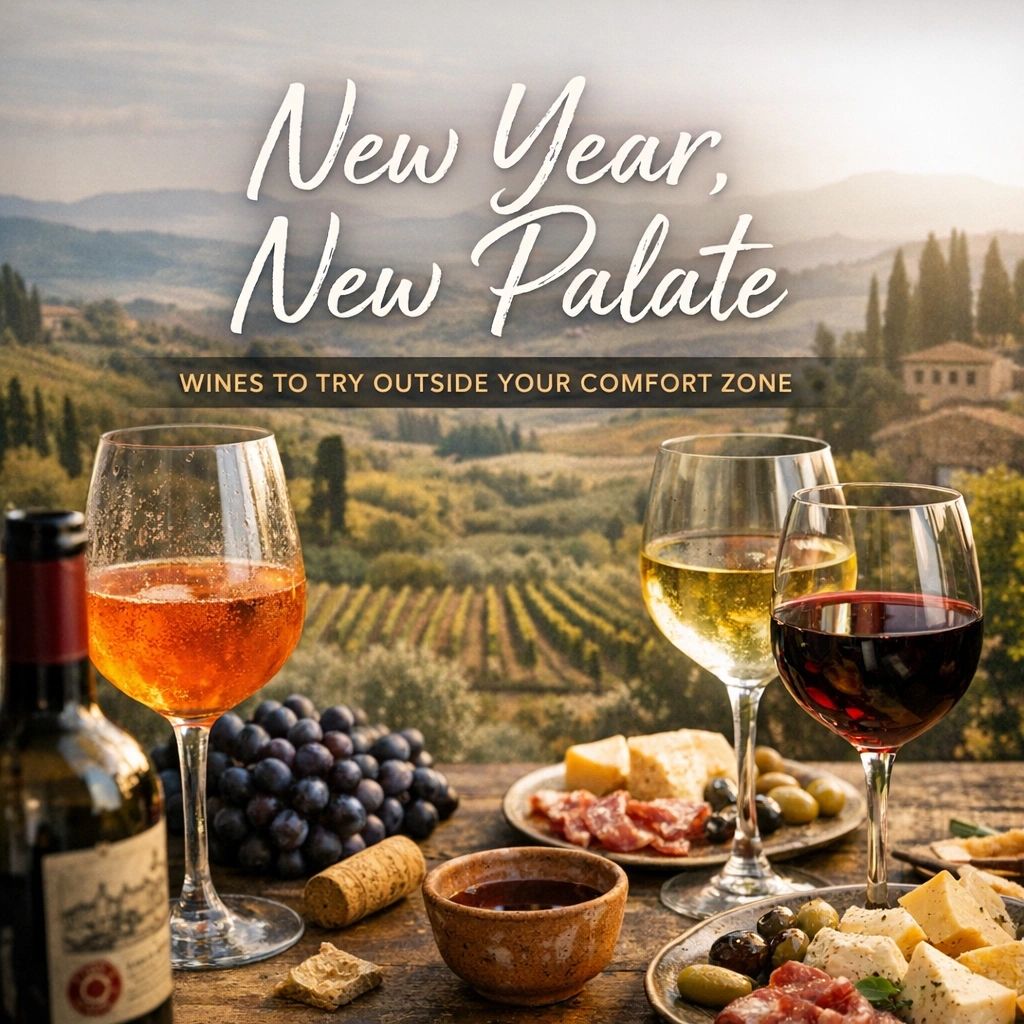
As a new year begins, many of us feel the familiar urge to reset—to rethink routines, refresh habits, and gently challenge ourselves to grow. In the world of wine, this impulse offers a perfect excuse to do something both pleasurable and illuminating: step outside your comfort zone. “New year, new palate” isn’t about abandoning your favorite bottle or forcing yourself to like something you don’t. It’s about curiosity—about widening the lens through which you taste, and discovering that pleasure often lives just beyond what feels familiar.
Most wine drinkers, even adventurous ones, settle into patterns. We find a grape we trust—Cabernet Sauvignon, Sauvignon Blanc, Pinot Grigio—and return to it again and again, often from the same regions and producers. There’s nothing wrong with this; comfort has its place. But wine is one of the few everyday luxuries that offers near-infinite variation, shaped by climate, soil, culture, and human philosophy. Limiting yourself to a narrow slice of it is like traveling the world but only ever ordering room service.
One of the simplest ways to expand your palate is to try a familiar grape from an unfamiliar place. If you love Chardonnay, consider one from Jura instead of California or Burgundy. Jura Chardonnays often lean leaner and more oxidative, with nutty, savory notes that challenge expectations of what the grape can be. If Malbec has always meant Argentina to you, seek out versions from Cahors, its historic home in southwest France, where the wines are darker, firmer, and more structured. The grape remains the same, but the expression tells a different story.
Another rewarding approach is to explore grapes that rarely headline wine lists but quietly thrive in their native regions. Grapes like Grüner Veltliner, Furmint, or Assyrtiko can feel intimidating simply because their names are unfamiliar, yet they often offer remarkable value and distinct personality. Grüner Veltliner, Austria’s signature white, can surprise Chardonnay lovers with its texture and peppery snap. Assyrtiko, grown in volcanic soils in Greece, delivers piercing acidity and mineral depth that pairs beautifully with food, especially seafood and Mediterranean dishes.
Red wine drinkers, too, can benefit from loosening their grip on the usual suspects. If your default is big, bold reds, consider trying something lighter but equally expressive, such as a Frappato from Sicily or a Gamay from Beaujolais. These wines often emphasize freshness, aromatics, and drinkability over sheer power, offering a different kind of satisfaction—one that invites another glass rather than demanding contemplation. They also challenge the assumption that “serious” wine must be heavy or expensive.
Venturing outside your comfort zone can also mean rethinking structure and style, not just grape variety. If you typically avoid wines labeled “natural,” try one made with minimal intervention from a reputable producer; you may discover that your aversion was shaped more by reputation than reality. Conversely, if you love highly polished wines, tasting something rustic or traditional can sharpen your understanding of balance, texture, and winemaking choices. These contrasts train the palate and deepen appreciation, even when a wine isn’t an instant favorite.
Importantly, expanding your palate isn’t about liking everything. Disliking a wine can be just as educational as loving one. It forces you to articulate why—too acidic, too tannic, too funky—and in doing so, you learn more about your own preferences. Over time, those preferences often evolve. Wines that once felt challenging can become compelling as your sensory vocabulary grows.
The new year is also an ideal moment to pair exploration with intention. Instead of buying wine reactively, choose a loose theme each month: a country you’ve never explored, a grape you can’t pronounce, or a style you’ve avoided. Let wine shops and sommeliers guide you; most are eager to share bottles that don’t sell themselves. These conversations, like the wines themselves, are part of the pleasure.
Ultimately, a “new palate” isn’t about chasing novelty for its own sake. It’s about staying open—about allowing wine to surprise you, teach you, and occasionally unsettle you. In a world that often rewards predictability, choosing curiosity is a small but meaningful act. As the year unfolds, your favorite bottle may still be waiting for you at the end of the day. But somewhere nearby is another wine, unfamiliar and unassuming, ready to expand what you thought you liked.


